Niagara Geopark Chair Perry Hartwick visits the Mixteca Alta UNESCO Global Geopark in Oaxaca, Mexico
My wife Shari and I love to travel, and when we do, we tend to seek out less obvious destinations that don’t necessarily fit well into a standard tourism package. We seem to find ourselves off the beaten track with only a vague itinerary in mind.
That kind of thinking is what recently took us to the colonial city of Oaxaca, Mexico for a week of fun and discovery. The historical centre of Oaxaca, a UNESCO World Heritage city, with its colonial architecture, pleasant cobblestone streets and outstanding restaurant and bar scene, is worth a long weekend visit anytime.
Oaxaca sits in the Valles Centrales, the sprawling, stunningly beautiful valley complex that stretches to the east, south and northwest. It is in the northwest direction that you will find the Mixteca Alta UNESCO Global Geopark, roughly an hour’s drive from the city. So off we went, to experience the Geopark first hand and to meet our hosts, Xochitl Ramirez-Miguel, Geoparque
Mixteca Alta founder and Chief Administrator, and Jose Luis Sanchez Cortez, PhD, Geopark Geologist.


Together, Xochitl and Jose Luis took us through the Geopark’s visitor centre to view interpretive panels, beautiful photographs, local Mixteca crafts and wonderful children’s artwork. We learned that the Geopark is a sparsely populated, economically poor area that has seen a steady flow of emigration for a long time. The area has been continuously inhabited for roughly 3,500 years but its heyday was during the post classic period from 1,000 to 1,500 AD, when the area was home to 50,000 inhabitants. Today, only 7,000 remain.
Owing to its remote location and lack of many tourism services, the Mixteca Geopark does not see many casual visitors. Most who come here do so as part of a scientific or sociological field trip from the Universidad Nacional Autonoma de Mexico. Indeed, one-hundred percent of the funding for the Geopark is supplied by that prestigious university, which certainly explains the emphasis on post secondary research and Geosite visits.
But, just as it is in Niagara, the deeper purpose of the Geopark, clearly, is to enhance the lives of the people who live here and to leverage education and awareness to enhance sustainable economic growth. To achieve this goal, Ms. Xochitl Ramirez-Miguel has made it her mission to excite local school children about the natural environment they live in and to pursue methods to enhance the local economy. For example, small samples of every rock type in the Geopark were collected and pulverized and displayed in little glass vials in a veritable rainbow of colours. Then each child was given the opportunity to create their own watercolor painting depicting an aspect of their lives within the Geopark. Many of these were proudly displayed at the visitor centre.


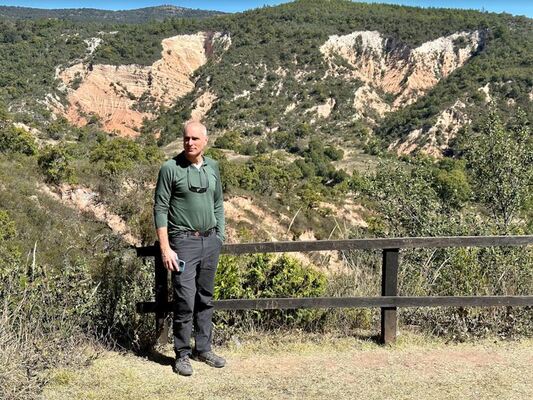
Naturally, I would be remiss if I did not talk about the Geology: One hundred million year old rock – volcanics, sandstones, shales – are exposed on the sides of hills and mountains everywhere you look. A geologist could amuse him/herself for days crawling all over this place. But the interesting part for me is that the nature of the exposures at Mixteca is much different than what we are used to seeing in Canada.
In our country, virtually all bedrock outcrops have only recently seen the light of day because glaciers were busy grinding and polishing rock surfaces as recently as only 15,000 years ago. Whereas the rocks in Mixteca have been slowly, continuously, relentlessly eroded by wind, rain, rivers, plants and animals for tens of millions of years – processes that have left behind a very unique-looking landscape.


The Geoparque Mixteca Alta will not, of course, appeal to everyone. It is rugged and arid with only basic accommodation and few dining options. But, if you are looking to meet some really friendly, welcoming people and experience a wild part of Mexico that few foreigners ever see, I suggest you pay a visit.