Building recognition through education, stewardship, partnership, and community so Niagara’s story is understood, celebrated, and protected for generations.
What Is a UNESCO Global Geopark?
UNESCO defines Global Geoparks as “single, unified geographical areas” where sites and landscapes of international geological significance are managed through protection, education, and sustainable development.
A UNESCO Global Geopark is not a regulatory designation. It does not create new land-use controls, restrict private property rights, or replace the authority of municipalities, conservation authorities, Indigenous governments, provincial agencies, or other existing decision-makers. Instead, designation recognizes a region’s commitment to understanding, sharing, and caring for its geological heritage in ways that support education, conservation, community pride, reconciliation, and sustainable local development.
For Niagara, this means telling a fuller story of place: one that connects globally significant geology with Indigenous knowledge, cultural heritage, environmental stewardship, education, agriculture, wine, tourism, and the communities that call this region home.
A Global and Canadian Network
UNESCO Global Geoparks are part of an international movement that connects places around the world through shared standards, collaboration, and knowledge exchange. There are currently 241 UNESCO Global Geoparks in 51 countries, including five in Canada: Cliffs of Fundy, Discovery, Percé, Stonehammer, and Tumbler Ridge.
The Global Geoparks Network supports collaboration among UNESCO Global Geoparks, helping members share best practices in geoconservation, education, sustainable tourism, community engagement, and local development. Membership in the Global Geoparks Network is required for UNESCO Global Geoparks.
The Canadian Geoparks Network supports Canada’s UNESCO Global Geoparks and aspiring Geoparks by encouraging collaboration, education, sustainable tourism, and strong application development. It also identifies Niagara as one of Canada’s potential Geoparks.
Visitors can explore the current global network through the UNESCO Global Geoparks map and the Global Geoparks Network map/poster, and learn more about Canada’s Geoparks through the Canadian Geoparks Network.
Niagara’s Geopark Story
Niagara Geopark brings together communities, Indigenous partners, educators, researchers, municipalities, conservation organizations, tourism operators, businesses, and residents to celebrate the geological and cultural layers of Ontario’s Niagara Peninsula.
Niagara’s landscape tells a story shaped over hundreds of millions of years by ancient seas, bedrock formation, glaciation, rivers, lakes, wetlands, the Niagara Escarpment, and the power of water. These forces continue to influence the region’s ecosystems, settlement patterns, agriculture, wine terroir, transportation corridors, tourism economy, and cultural identity.
As an Aspiring UNESCO Global Geopark, Niagara is working to make this story more visible, accessible, and meaningful for residents and visitors. This includes strengthening public education, expanding interpretation at geosites, supporting Indigenous-led knowledge sharing, developing digital learning tools, building sustainable tourism experiences, and connecting people to the places and stories that define Niagara.
How UNESCO Designation Works
The UNESCO Global Geopark designation process is rigorous and multi-year. An aspiring Geopark must demonstrate that it has geological heritage of international significance, a clearly defined and unified territory, an effective management structure, a comprehensive management plan, strong partnerships, public visibility, educational programming, community engagement, and active connections with other Geoparks and the Global Geoparks Network.
The formal UNESCO process includes a letter of intent, submission of application documents, desktop review, field evaluation by UNESCO-appointed evaluators, assessment by the UNESCO Global Geoparks Council, and a final decision by UNESCO’s Executive Board.
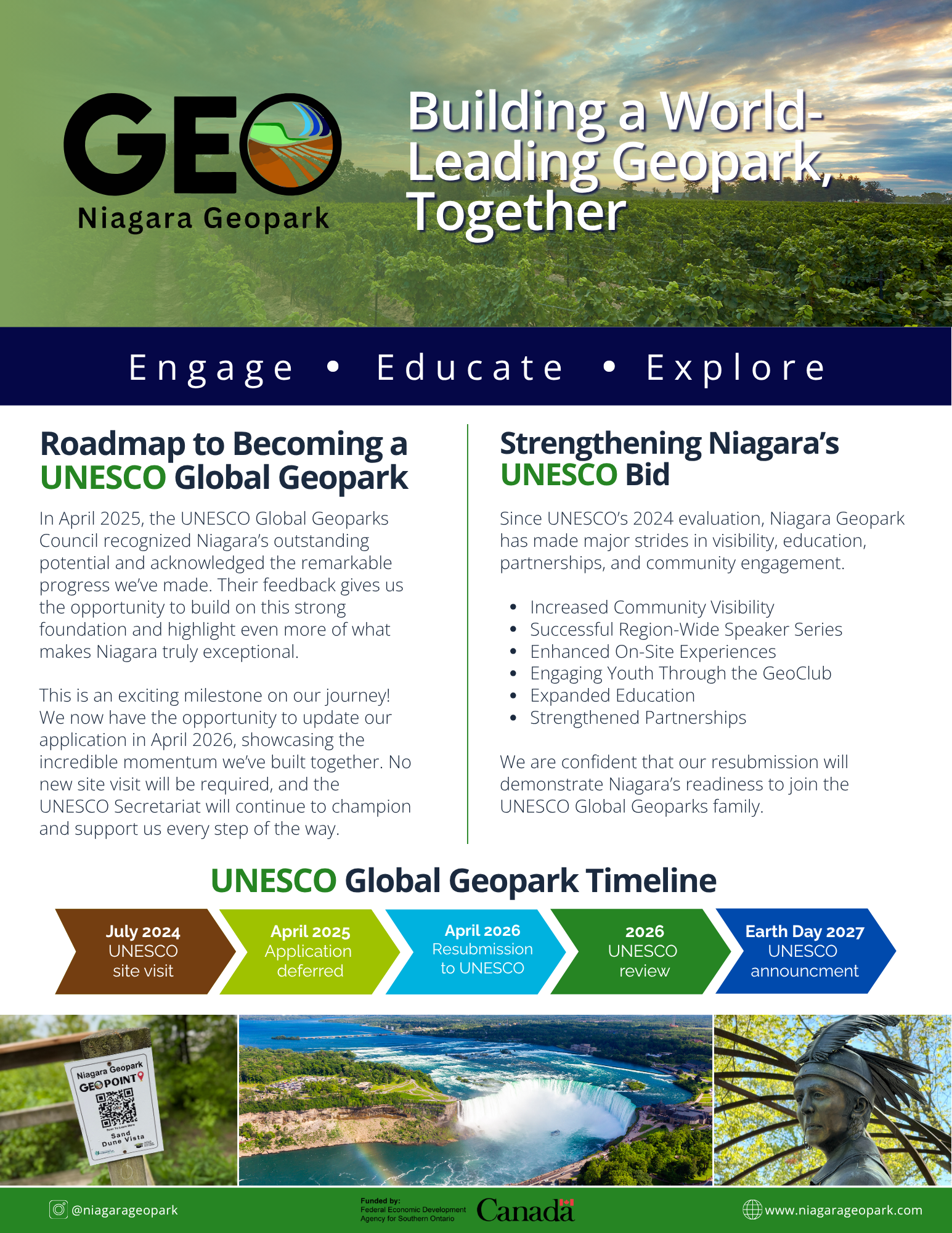
Niagara Geopark has submitted its resubmission materials for final consideration and is working toward anticipated UNESCO decision-making in 2027. During this period, the Geopark continues to implement projects, strengthen partnerships, expand education, improve visibility, and demonstrate that Niagara is ready to join the UNESCO Global Geoparks Network.
Designation Is an Ongoing Commitment
UNESCO Global Geopark designation is not permanent. Once designated, each UNESCO Global Geopark is revalidated every four years through a formal review process that includes a progress report and field evaluation. This ensures that Geoparks continue to meet international standards and remain active, accountable, and responsive to their communities.
This ongoing evaluation process is important. It means Niagara’s work does not end with designation. Instead, designation marks the beginning of a long-term commitment to education, stewardship, partnership, sustainable development, and continuous improvement.
What Niagara Is Doing Now
Niagara Geopark’s path to UNESCO designation is rooted in action. Across the region, work is underway to expand public education and digital learning, improve on-site interpretation and signage, strengthen Indigenous partnerships and knowledge-sharing, and build new ways for people to explore Niagara more deeply.
This work includes the Niagara Geopark Learning Hub, school and public programming, interpretive signage, GeoClub activities, digital storytelling, Geopark Corners at partner sites, and the development of the Niagara Geopark Trail Network and map-based discovery tools.
Together, these initiatives connect geosites, trails, cultural landmarks, Indigenous knowledge, local businesses, and community stories through meaningful, place-based exploration.
The Geopark also supports sustainable tourism and regional pride by encouraging experiences that celebrate Niagara’s distinct landscapes, stories, communities, and local economies.
How the Community Can Help
UNESCO designation depends on a region-wide commitment to learning, participation, and shared stewardship.
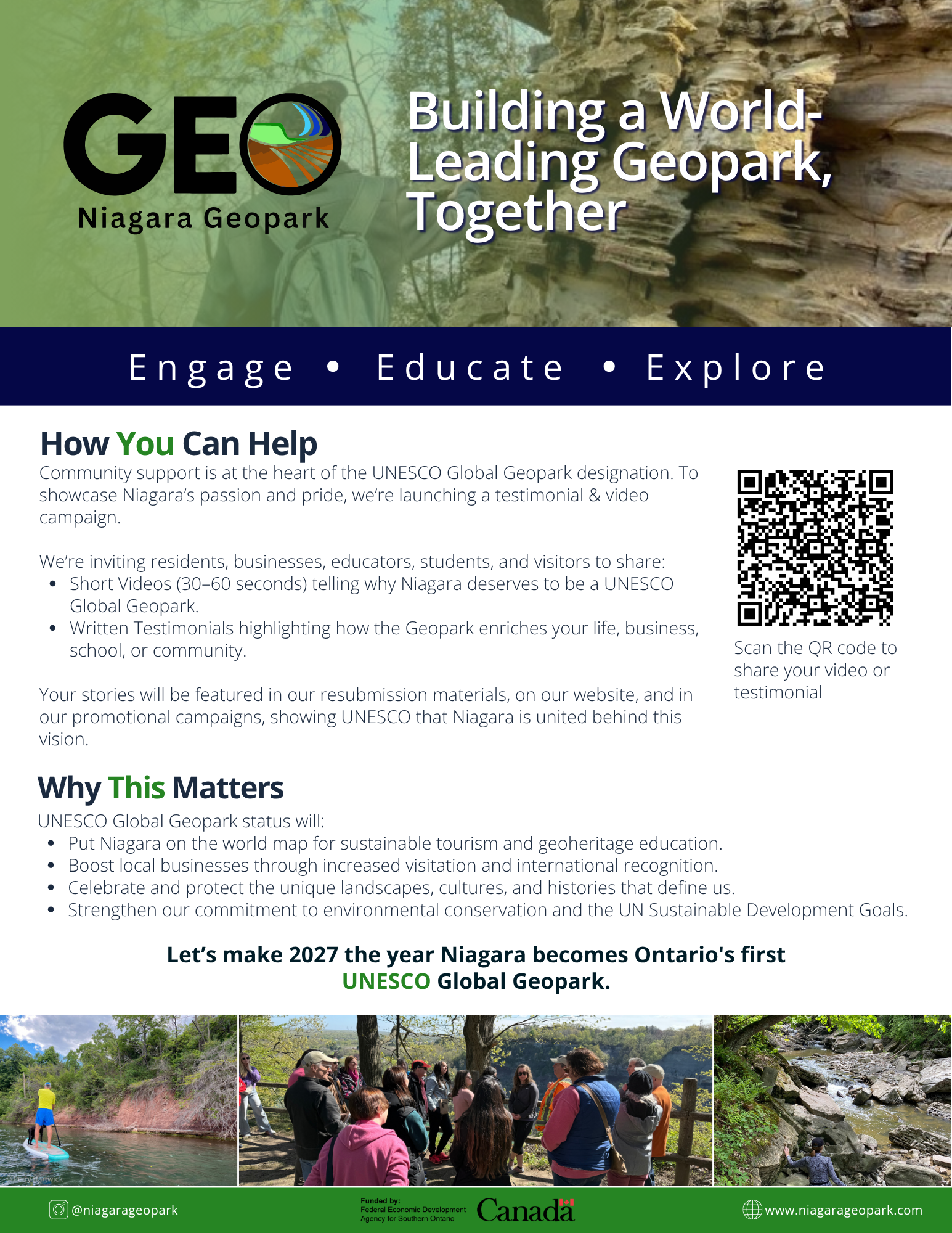
Community members can help by attending events, taking a course, exploring Niagara with care, supporting local partners, volunteering, becoming ambassadors, sponsoring programs, donating, or partnering with the Geopark in new ways.
Every action helps build the understanding, momentum, and shared sense of purpose needed to carry Niagara’s UNESCO journey forward. By working together, Niagara can take its place within a global network of communities that are protecting geological heritage, advancing education, supporting sustainable tourism, and sharing the stories of the Earth with the world.