A Journey to the Pristine Middle Layers of the Niagara Escarpment – Confessions of a Tour Guide
An Exploration of the Niagara Escarpment’s Midsection
Enter into an uncomfortable but rewarding world, where the Niagara Escarpment’s steep slopes and cliffs have remained preserved in time, and hold secrets to the past about biodiversity and Niagara’s human culture.
The beautiful Bruce Trail is the main hiking artery along the top of the Escarpment (marked in white rectangular blazes), giving hikers unforgettable views of Niagara-on-the-Lake’s stunning countryside. With lookouts standing above the canopy of old-growth forests, you can almost feel the Escarpment’s historical energy coming up through your feet.
The Niagara Escarpment – Past, Present & Future
There are a handful of locations along Niagara-on-the-Lake’s section of the Niagara Escarpment where the War of 1812 sifted and shot its way through the dense forests. The high cliffs were used as strategic vantage points to observe volatile landscapes at Queenston Heights, the top of Concession 2, and Woodend. At that point, timber rattlesnakes and wolves likely still inhabited the rocky crags.
There is a lot of human energy and history along the top rim of the Escarpment. Indigenous Peoples had certainly used the prevailing edge of the Escarpment as a navigational tool, which runs a consistent East-West progression here on the Niagara Peninsula. Generally speaking, Lake Ontario is north of the Escarpment’s face at most times around here.
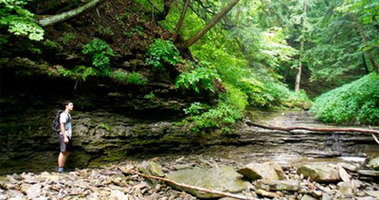
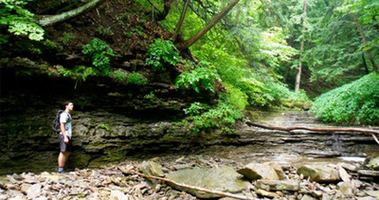
At a glance form up top, you may see another trail running down below at the bottom of the humongous drop. Indigenous Peoples would have used such vistas as ideal hunting points, watching the once numerous game walk down below. This is now where parts of the Laura Secord Trail and various Bruce Trail side trails (marked in blue rectangular blazes) run along the base of the Escarpment. These trails have a generous amount of free parking and access points between Queenston and Woodend. They offer views facing up the Escarpment, rather than the classic clifftop view.
It’s a look at the forest mansion from the ground up, versus from the top window out. It’s a beautiful world where the sun drapes down in different densities. At mid-summer, barely any sunlight reaches the forest floor through the green cloak above. Between this factor, and the inevitable angular shade that covers the slope, a world of mosses, ferns, and other cool shady species take hold to the rocks.
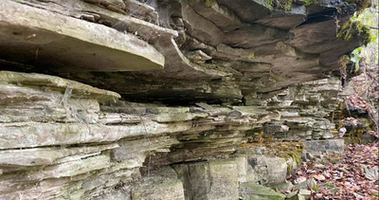
Sometimes, these piles of rocks on the midsection of the Escarpment form a collective ecosystem that lies as a “belt” between the upper and lower tier of the cliff. Essentially, we’re talking about the inaccessible area of the Niagara Escarpment.
An Abundance of Wildlife in a Sheltered Oasis
Because of the cooler and more protected conditions I described before, the species richness for such plant groups are a statement to their sheltered existence. The well-drained rocky mess is also an essential hibernation space for snakes; five species of snake call the Niagara Escarpment in NOTL home, none of which are venomous.
The Fall colours reveal how some species of tree prefer the well-drained top of the Escarpment, while other species change colour according to their lives which prefer the wetter lowlands. Some specialize in the area that lies between the top and the bottom.
The scree slopes (hillsides where rocks pile up from tumbling down over time) and steep pitches are where relatively undisturbed habitats still lie. In my Hidden Corners filming trips to remote landscapes in other parts of the world, as well as Niagara’s deepest locales, I found myself thanking gravity and inaccessible slopes, as they have so far disallowed profound human developments to take them over.
The steep slopes have been spared the habitation and travel of humans compared to the flatter upper and lower parts. This has allowed for another network of animals to subside on these slopes, including our local canid, the coyote. I’ve taken many shady climbs over these shady slopes, watchful for pockets of poison ivy. I have found many impressive burrows embedded into the Escarpment over the years. Their size, the scat (coyote droppings), and other activity nearby indicate that some coyote burrows have interwoven in local spots, where they stay clear of the slightly busier lands above and below. This is a safe space for these important ecosystem regulators to shelter and raise their young. Without wolves, cougars, bears, and other historic predators, it’s up to coyotes to maintain the remaining balance.
Finding Solace from Winter in the Escarpment’s Complex Caverns
The fascinating and perhaps relatable aspect of these complex caverns is that they are shared by multiple species, at any point in the year. Totally different life forms most congregate and coexist in order to survive the frigid Canadian winter. A coyote’s cavern, in the world of nature and no concept of private property, is a home to many other creatures as well. The aforementioned snakes, the salamanders, rabbits, moles, and countless insects will shelter in the confines of these channels in the Escarpment. While this community forms on the forest floor of a slippery slope, the inhabitants of the trees take shelter from such animals, or, choose to hunt them from above. That depends on where nature has caught you in the food web, though.
The conduits, which polka dot the land in between the top and bottom, therefore help add to the overall biodiversity that we shelter here in Niagara-on-the-Lake. My home becomes yours, and yours is mine, until we must eat. Statistically, the midsection area of the Niagara Escarpment is so much less disturbed in terms of modern and historical usage than the upper and lower areas. In the land of waterfalls in between waterfalls, the quieter realms of the Niagara Escarpment are places of biological and historical wonder on a national scale. I recommend taking a local hike at this time of year, or well into winter, in order to fully gaze upon the shape of the landscape that has shaped us.